I've made a previous post about Specific Impulse, but I've wanted to improve it for a while, since it's not very clear. This post is using a new system called MathJax to display equations, which should make them easier to read.
Specific impulse is essentially a measure of how efficiently a rocket engine converts the chemical potential energy of its fuel into the kinetic energy driving the rocket forward. It is defined as the thrust of a rocket engine $T$ divided by the weight flow rate $\dot{W}$: $$I_{sp}=\frac{T}{\dot{W}}$$ First, we need to distinguish between weight and mass. Mass is how much matter an object consists of, while weight is the force exerted on an object by the local gravitational field. The local gravity on Earth exerts 9.81 m/s^2 of acceleration on everything, so if force = mass times acceleration, the force, or weight, exerted by an object with 1 kg of mass is 1 kg * 9.81 m/s^2. Since one Newton is the amount of force needed to accelerate one kg at 1 m/s^2, the object has a weight of 9.81 N. Weight is normally measured in kilograms (or pounds, but they're the same dimensionally), which seems odd, since we know weight can change independently of mass on different planets with different gravities. This is because the unit commonly referred to by a kilogram is actually kilogram-force, or a kilopond, which is exactly the force of one kilogram of mass in standard Earth gravity, or about 9.81 N. Therefore, in common use, both the definition and unit of mass and weight are the same.
Specific impulse $I_{sp}$ is defined as the thrust $T$ produced by a rocket engine, divided by the weight flow rate of propellant $\dot{W}$, or: $${I_{sp}}=\frac{T}{\dot{W}}$$ It seems like it should be thrust per unit weight of propellant consumed, but thrust is instantaneous, so it wouldn't make sense without converting to some weird unit like newton-seconds.
Since $\dot{W}$ is weight, and weight is mass multiplied by standard gravity, the weight flow rate is the mass flow rate $\dot{m}$ multiplied by gravity: $$\dot{W}=g\dot{m}$$ The mass flow rate is the first derivative of the propellant mass $m_p$ with respect to time: $$\dot{m}=\frac{dm_p}{dt}$$ Therefore: $$\dot{W}=g\frac{dm_p}{dt}$$
Thrust is simply the exhaust velocity of the propellant from the engine $v_e$ multiplied by the mass flow rate $\dot{m}$ which is exactly the same as the mass flow rate already defined: $$T=v_e\frac{dm_p}{dt}$$
If we substitute these back into the original $I_{sp}$ formula, we get: $$I_{sp}=\frac{v_e\frac{dm_p}{dt}}{g\frac{dm_p}{dt}}$$ Since the mass flow rate is on both the top and bottom of the equation, we can get rid of them, and get: $$I_{sp}=\frac{v_e}{g}$$ The important thing to remember here is that $g$ is a constant in this equation. It is quite literally the acceleration due to gravity at the earth's surface, regardless of where the rocket engine is, or what kind of gravity it is in. In fact, any constant with the unit of $m/s^2$ would work. Not only that, but when calculating $\Delta{V}$ using a specific impulse term, as is frequently seen, the specific impulse term is multiplied by $g$, turning the term back into $v_e$. Another weird effect of this is that specific impulse has a unit of seconds.
This weird definition was originally used, as far as I can tell, because the unit of seconds is the same whether you're using metric or imperial units to calculate it, which is less confusing than m/s and ft/s. Using metric units, exhaust velocity and specific impulse can be calculated approximately by multiplying or dividing by ten. In short, specific impulse is a way of making exhaust velocity, which is the real measure of rocket engine efficiency, into a number which is the same whatever units you use to calculate it.
Interestingly, $v_e$ is effective exhaust velocity, which takes into account any propellant not exhausted at the full velocity of the engine, such as with turbine exhaust or film cooling. Effective exhaust velocity can be calculated on an existing engine with the specific impulse formula by using: $$v_e=\frac{T}{\dot{m}}$$ Except $T$ and $\dot{m}$ are based on measurements of a engine rather than calculated.
Showing posts with label delta-v. Show all posts
Showing posts with label delta-v. Show all posts
Monday, May 21, 2018
Sunday, July 2, 2017
Alternate ITS missions part 3
This post got too long again, so I'm splitting it into yet another section. This will cover how to calculate interplanetary trajectories.
All orbits are conic sections. circles, ellipses, parabolas, or hyperbolas. Circles and ellipses are the orbits that a spacecraft is in when it is in a stable orbit around a planet. Parabolas are when the spacecraft is going at exactly escape velocity, and hyperbolas are when the spacecraft is going faster than escape velocity.
For ellipses (assuming circles are a type of ellipse) the planet the spacecraft is orbiting (or the primary) is always at one of the two foci. The major and minor axes are the longest and the shortest lines that can be drawn through the ellipse, respectively. The semi-major or minor axes are half of the major or minor axes.
The periapsis is the lowest point on an orbit, and the apoapsis is the highest. They are always 180 degrees apart. The closer to the periapsis, the faster the satellite travels, and the closer to apoapsis, the slower.
A quick aside on nodes: nodes are the points at which the orbit passes the plane of the equator or ecliptic. The ascending node is the one the spacecraft passes travelling from south to north, and the descending node is the one the spacecraft passes travelling from north to south.
Eccentricity is the distance between the foci divided by the length of the major axis (always between 0 and 1 except for hyperbolas), and is essentially a measure of how "squished" the ellipse is. 0 is a circle, 1 is parabola, > 1 is a hyperbola.
Inclination is how tilted the orbit is from the equatorial plane (or the ecliptic) of the primary. An inclination of less than 90 degrees indicates a orbit in the same direction as the spin of the primary, or prograde, an inclination of greater than 90 degrees means that the orbit is in the opposite direction of the spin, or retrograde.
I'm ignoring how to calculate these, as that would make this post much longer.
So, let's imagine you want to go from one circular orbit to another. What is the most efficient way of doing this? The answer is a Hohmann transfer.

A Hohmann transfer is the most efficient way to go from a coplanar orbit to another. The image shows a transfer with two circular orbits, however it is the most efficient for any two coplanar orbits where one cannot be reached from the other with only a single burn. For example, in the image, 1 and 3 require a hohmann transfer, while 1 and 2 or 2 and 3 only need a single burn.
The Delta-V required for a hohmann transfer is the sum of the Delta-V required for the burn to go from 1 to 2, and the Delta-V required to go from 2 to 3. It is the same in the opposite direction (3 to 1 = 3 to 2 + 2 to 1), and the burns are the same, except with the spacecraft burning its engines in the opposite direction.
The transfer orbit between two planets is the same thing, with the transfer orbit going from one planet to another, except for the fact that you start in orbit around one of those planets.
Transfer windows are times when the orbits of the planets align such that a spacecraft on a transfer orbit reaches apoapsis (or periapsis) at the same time as the destination planet moves through the part of the orbit that intersects the transfer orbit.
It isn't very important to calculate transfer windows for this post, as they do occur regularly for most planets.
Delta-V for an interplanetary transfer is less than you might expect, as the Oberth effect comes into play on the escape burn. The Oberth effect is, in short, an effect that makes Delta-V count for more when near a large mass. It is why the Delta-V required for a hohmann transfer to GEO is more than the Delta-V required for escape velocity.
The Oberth effect is the effect of the extra velocity of a circular orbit around earth has compared to a circular orbit around the sun at earth's altitude. As the satellite orbits around the earth, it traces out a spiral pattern relative to the sun. When it is orbiting in the same direction around the earth that the earth is orbiting around the sun, the velocity relative to the sun is increased. It isn't as simple as adding the velocities, but we'll get into that later.
On arrival at the destination planet, the Delta-V can be further reduced with aerobraking or aerocapture. This is where the you use the atmosphere of the planet you are arriving at to slow down or speed up without using any fuel. This only works on planets with atmospheres, though, and you cannot capture into a circular orbit without a burn, although it is much less with most of the velocity bled off already.
A very useful equation is the Vis-visa equation:
v^2 = GM(2/r - 1/a)
Where v is the speed of the spacecraft at any point in a orbit, G is the gravitational constant, M is the mass of the primary, r is the distance between the spacecraft and the primary at the point at which you wish to know velocity, and a is the semi-major axis.
The calculations for hohmann transfer orbits assume instantaneous impulses, which lessens delta-v requirements. To compensate, I will multiply the estimate by 1.1.
To calculate Delta-V requirements, you simply need to get the difference in velocities between the orbits at the correct points. This is why the Vis-visa equation is so useful.
We apply this to a hohmann transfer from one planet to another, getting the velocities of the transfer at apoapsis and periapsis. Then, we calculate the velocity of the starting orbit, and calculate the required Delta-V to go to the transfer orbit, accounting for the Oberth effect.
Reversing the rocket equation will then let us calculate payload.
Earth to Venus example
Earth has a mass of 5.9723 * 10^24 kg. It has a semi-major axis of 149.6 * 10^9 meters. Its orbital radius goes from 147.09 * 10^9 m to 152.1 * 10^9 m.
Venus has a mass of 4.8675 * 10^24 kg. It has a semi-major axis of 108.21 * 10^9 m. Its orbital radius goes from 107.48 * 10^9 m to 108.94 * 10^9 m.
The sun has a mass of 1988500 * 10^24 kg.
A transfer orbit between them depends on the position of the planets at departure and arrival. For this example, the position of Venus does not matter, as aerobraking will work at either of those speeds.
Earth should be at apoapsis, because in this case we want to lose, rather than gain, velocity as Venus is in a lower orbit than Earth.
Let's begin. First, the velocity of Earth around the Sun at apoapsis. We don't really need to calculate this, as it is well known: 29290 m/s.
The transfer orbit is an elliptical orbit with its apoapsis at Earth, and its periapsis at Venus. This gives a semi-major axis of:
(Radius of Earth's orbit at departure + Radius of Venus' orbit at arrival)/2.
Or (152.1 * 10^9 m + 108.94 * 10^9 m)/2 = 130.52 * 10^9 m.
Velocity at apoapsis:
v^2 = 1.327 * 10^20 (2/152.1 * 10^9 - 1/130.52 * 10^9)
v = 26985 m/s
At periapsis:
v^2 = 1.327 * 10^20 (2/108.94 * 10^9 - 1/130.52 * 10^9)
v = 37676 m/s
The velocity of the spaceship in Earth orbit can be calculated from the altitude, and the altitude is as low as possible to take maximum advantage of the Oberth effect. I'm going to guess around 200 km.
v^2 = 3.986 * 10^14 (2/6578000 - 1/6578000)
v = 7784 m/s.
To figure out how much of an advantage the Oberth effect gives us, we use something called hyperbolic excess velocity. This is how much extra velocity the spaceship will have when it reaches infinite distance on a hyperbolic escape orbit. If you reach exactly escape velocity, HEV will be zero. The desired HEV is equal to the orbital velocity of the primary - the velocity of the transfer orbit at the point where it begins so when the spacecraft escapes the primary's gravity, the remaining velocity puts it on the transfer orbit.
The equation for HEV is HEV^2 = v^2 - ve^2
Our desired HEV is 29290 - 26985 = 2305.
Rearranging the equation:
v^2 =2305^2 + 11008^2.
(as escape velocity is equal to the velocity of a circular orbit at that altitude times √2)
So v = 11246 m/s.
11246 - 7784 = 3462.
Here you can see the clear advantage of this over a escape burn (3224) + a burn outside of Earth's sphere of influence to put the spacecraft on a transfer orbit (2305), which would be 2067 m/s more.
Venus is inclined 3.39 degrees off of Earth, however this amounts to at most a few m/s if it is corrected for at the very start of the transfer. For this kind of loose approximation, we can ignore this.
So, multiplying by 1.1, we have a Delta-V of 3808 m/s.
Next post, we will calculate transfers for other missions, including approximate landing Delta-V, and use the reverse rocket equation to figure out how much payload can be carried to them.
All orbits are conic sections. circles, ellipses, parabolas, or hyperbolas. Circles and ellipses are the orbits that a spacecraft is in when it is in a stable orbit around a planet. Parabolas are when the spacecraft is going at exactly escape velocity, and hyperbolas are when the spacecraft is going faster than escape velocity.
For ellipses (assuming circles are a type of ellipse) the planet the spacecraft is orbiting (or the primary) is always at one of the two foci. The major and minor axes are the longest and the shortest lines that can be drawn through the ellipse, respectively. The semi-major or minor axes are half of the major or minor axes.
The periapsis is the lowest point on an orbit, and the apoapsis is the highest. They are always 180 degrees apart. The closer to the periapsis, the faster the satellite travels, and the closer to apoapsis, the slower.
A quick aside on nodes: nodes are the points at which the orbit passes the plane of the equator or ecliptic. The ascending node is the one the spacecraft passes travelling from south to north, and the descending node is the one the spacecraft passes travelling from north to south.
Eccentricity is the distance between the foci divided by the length of the major axis (always between 0 and 1 except for hyperbolas), and is essentially a measure of how "squished" the ellipse is. 0 is a circle, 1 is parabola, > 1 is a hyperbola.
Inclination is how tilted the orbit is from the equatorial plane (or the ecliptic) of the primary. An inclination of less than 90 degrees indicates a orbit in the same direction as the spin of the primary, or prograde, an inclination of greater than 90 degrees means that the orbit is in the opposite direction of the spin, or retrograde.
I'm ignoring how to calculate these, as that would make this post much longer.
So, let's imagine you want to go from one circular orbit to another. What is the most efficient way of doing this? The answer is a Hohmann transfer.

Image from Leafnode
The Delta-V required for a hohmann transfer is the sum of the Delta-V required for the burn to go from 1 to 2, and the Delta-V required to go from 2 to 3. It is the same in the opposite direction (3 to 1 = 3 to 2 + 2 to 1), and the burns are the same, except with the spacecraft burning its engines in the opposite direction.
The transfer orbit between two planets is the same thing, with the transfer orbit going from one planet to another, except for the fact that you start in orbit around one of those planets.
Transfer windows are times when the orbits of the planets align such that a spacecraft on a transfer orbit reaches apoapsis (or periapsis) at the same time as the destination planet moves through the part of the orbit that intersects the transfer orbit.
It isn't very important to calculate transfer windows for this post, as they do occur regularly for most planets.
Delta-V for an interplanetary transfer is less than you might expect, as the Oberth effect comes into play on the escape burn. The Oberth effect is, in short, an effect that makes Delta-V count for more when near a large mass. It is why the Delta-V required for a hohmann transfer to GEO is more than the Delta-V required for escape velocity.
The Oberth effect is the effect of the extra velocity of a circular orbit around earth has compared to a circular orbit around the sun at earth's altitude. As the satellite orbits around the earth, it traces out a spiral pattern relative to the sun. When it is orbiting in the same direction around the earth that the earth is orbiting around the sun, the velocity relative to the sun is increased. It isn't as simple as adding the velocities, but we'll get into that later.
On arrival at the destination planet, the Delta-V can be further reduced with aerobraking or aerocapture. This is where the you use the atmosphere of the planet you are arriving at to slow down or speed up without using any fuel. This only works on planets with atmospheres, though, and you cannot capture into a circular orbit without a burn, although it is much less with most of the velocity bled off already.
A very useful equation is the Vis-visa equation:
v^2 = GM(2/r - 1/a)
Where v is the speed of the spacecraft at any point in a orbit, G is the gravitational constant, M is the mass of the primary, r is the distance between the spacecraft and the primary at the point at which you wish to know velocity, and a is the semi-major axis.
The calculations for hohmann transfer orbits assume instantaneous impulses, which lessens delta-v requirements. To compensate, I will multiply the estimate by 1.1.
To calculate Delta-V requirements, you simply need to get the difference in velocities between the orbits at the correct points. This is why the Vis-visa equation is so useful.
We apply this to a hohmann transfer from one planet to another, getting the velocities of the transfer at apoapsis and periapsis. Then, we calculate the velocity of the starting orbit, and calculate the required Delta-V to go to the transfer orbit, accounting for the Oberth effect.
Reversing the rocket equation will then let us calculate payload.
Earth to Venus example
Earth has a mass of 5.9723 * 10^24 kg. It has a semi-major axis of 149.6 * 10^9 meters. Its orbital radius goes from 147.09 * 10^9 m to 152.1 * 10^9 m.
Venus has a mass of 4.8675 * 10^24 kg. It has a semi-major axis of 108.21 * 10^9 m. Its orbital radius goes from 107.48 * 10^9 m to 108.94 * 10^9 m.
The sun has a mass of 1988500 * 10^24 kg.
A transfer orbit between them depends on the position of the planets at departure and arrival. For this example, the position of Venus does not matter, as aerobraking will work at either of those speeds.
Earth should be at apoapsis, because in this case we want to lose, rather than gain, velocity as Venus is in a lower orbit than Earth.
Let's begin. First, the velocity of Earth around the Sun at apoapsis. We don't really need to calculate this, as it is well known: 29290 m/s.
The transfer orbit is an elliptical orbit with its apoapsis at Earth, and its periapsis at Venus. This gives a semi-major axis of:
(Radius of Earth's orbit at departure + Radius of Venus' orbit at arrival)/2.
Or (152.1 * 10^9 m + 108.94 * 10^9 m)/2 = 130.52 * 10^9 m.
Velocity at apoapsis:
v^2 = 1.327 * 10^20 (2/152.1 * 10^9 - 1/130.52 * 10^9)
v = 26985 m/s
At periapsis:
v^2 = 1.327 * 10^20 (2/108.94 * 10^9 - 1/130.52 * 10^9)
v = 37676 m/s
The velocity of the spaceship in Earth orbit can be calculated from the altitude, and the altitude is as low as possible to take maximum advantage of the Oberth effect. I'm going to guess around 200 km.
v^2 = 3.986 * 10^14 (2/6578000 - 1/6578000)
v = 7784 m/s.
To figure out how much of an advantage the Oberth effect gives us, we use something called hyperbolic excess velocity. This is how much extra velocity the spaceship will have when it reaches infinite distance on a hyperbolic escape orbit. If you reach exactly escape velocity, HEV will be zero. The desired HEV is equal to the orbital velocity of the primary - the velocity of the transfer orbit at the point where it begins so when the spacecraft escapes the primary's gravity, the remaining velocity puts it on the transfer orbit.
The equation for HEV is HEV^2 = v^2 - ve^2
Our desired HEV is 29290 - 26985 = 2305.
Rearranging the equation:
v^2 =2305^2 + 11008^2.
(as escape velocity is equal to the velocity of a circular orbit at that altitude times √2)
So v = 11246 m/s.
11246 - 7784 = 3462.
Here you can see the clear advantage of this over a escape burn (3224) + a burn outside of Earth's sphere of influence to put the spacecraft on a transfer orbit (2305), which would be 2067 m/s more.
Venus is inclined 3.39 degrees off of Earth, however this amounts to at most a few m/s if it is corrected for at the very start of the transfer. For this kind of loose approximation, we can ignore this.
So, multiplying by 1.1, we have a Delta-V of 3808 m/s.
Next post, we will calculate transfers for other missions, including approximate landing Delta-V, and use the reverse rocket equation to figure out how much payload can be carried to them.

Sunday, April 30, 2017
Alternate ITS missions part 1
The Interplanetary Transport System is a spacecraft concept developed by SpaceX and designed to colonize Mars. While it is designed for that specific goal, it could feasibly be adapted to other missions. This post, part 1, talks about the performance of the ITS, and the second part will talk about what missions it is capable of.
The ITS has two configurations, the ship, and the tanker. The ship is designed to carry 450t or 100 people to Mars, while the tanker is designed to refuel the ship in Earth orbit.
Let's take a closer look at the performance.
First of all, the maximum delta-v.
Using the Tsiolkovsky rocket equation (DV = Ve*ln(minitial/mfinal)) like so:
DV = 3,747.42*ln(2100/150) = 9889 m/s
This is an impressively high delta-v, however it assumes no payload, with the standard ITS configuration (not the tanker).
With the tanker configuration:
DV = 3,747.42*ln(2590/90) = 12589 m/s
This also assumes no payload.
You can calculate how much delta-v you need for transfers between planets with a porkchop plot, or you could just use a handy delta-v map of the solar system that assumes reasonably efficient transfers.
 (Chart from Atomic Rockets)
We can reverse the rocket equation to find out how much payload we can carry, given a specific required delta-v. Wolfram|alpha can do this for us easily, and the answer is mfinal = minitial*ℯ-DV/VE
ℯ = Euler's constant, or ~2.71.
Payload equals mfinal - empty mass
Empty mass differs between the tanker and the standard ITS configuration by 60t. It's hard to tell what of that is necessary for a much smaller crew, as might be used on these missions. A safe bet is probably around 120t, halfway between the two numbers.
Propellant mass also differs, with 1950t for the ship and 2500t for the tanker. In this case, to keep costs low, the ship value of 1950t would be used, as there is no space for crew in the tanker, and changing the size and shape of the composite tanks is expensive.
Note that while SpaceX uses a value of 6km/s from low earth orbit (LEO) to trans-Mars injection (TMI), more efficient (but slower) transfers use on the order of 3-4km/s. Presumably, this is done to minimize life support costs; both consumables and radiation shielding. However, if you're sending 5 people instead of 100, consumable costs per day only scale 1/20 as fast per unit time, so almost any other missions would sacrifice travel speed for payload.
The ITS has 3 sea level Raptor engines, and 6 vacuum Raptors. Basically, in a vacuum you could use the sea level engines in addition to the vacuum engines, but it would just hurt our delta-v. In an atmosphere, you can't use the vacuum engines due to flow separation, which happens when your engine is overexpanded. (flow separation is an extreme example of what causes the space shuttle main engines to wobble as they start up, as they have to be efficient throughout the entire atmosphere: https://www.youtube.com/watch?v=hDCCBgppG4s)
So the ITS has different thrust-to-weight ratios (TWR) for different situations.
3*SL Raptor = 9150kn = 933 metric tons-force = empty TWR of 7.775
= loaded TWR of 0.45
6*VAC Raptor = 21000kn = 2141 metric tons-force = empty TWR of 17.84
= loaded TWR of 1.03
Max possible thrust in VAC = 3074 metric tons-force = empty TWR of 25.62
= loaded TWR of 1.49
These are all assuming you're on Earth, with no payload.
The ITS can withstand 10-15gs, and a minimum of 1,700 degrees C.
In the next part we will go over what missions the ITS could perform now that we have determined its performance.
The ITS has two configurations, the ship, and the tanker. The ship is designed to carry 450t or 100 people to Mars, while the tanker is designed to refuel the ship in Earth orbit.
Let's take a closer look at the performance.
First of all, the maximum delta-v.
Using the Tsiolkovsky rocket equation (DV = Ve*ln(minitial/mfinal)) like so:
DV = 3,747.42*ln(2100/150) = 9889 m/s
This is an impressively high delta-v, however it assumes no payload, with the standard ITS configuration (not the tanker).
With the tanker configuration:
DV = 3,747.42*ln(2590/90) = 12589 m/s
This also assumes no payload.
You can calculate how much delta-v you need for transfers between planets with a porkchop plot, or you could just use a handy delta-v map of the solar system that assumes reasonably efficient transfers.

We can reverse the rocket equation to find out how much payload we can carry, given a specific required delta-v. Wolfram|alpha can do this for us easily, and the answer is mfinal = minitial*ℯ-DV/VE
ℯ = Euler's constant, or ~2.71.
Payload equals mfinal - empty mass
Empty mass differs between the tanker and the standard ITS configuration by 60t. It's hard to tell what of that is necessary for a much smaller crew, as might be used on these missions. A safe bet is probably around 120t, halfway between the two numbers.
Propellant mass also differs, with 1950t for the ship and 2500t for the tanker. In this case, to keep costs low, the ship value of 1950t would be used, as there is no space for crew in the tanker, and changing the size and shape of the composite tanks is expensive.
Note that while SpaceX uses a value of 6km/s from low earth orbit (LEO) to trans-Mars injection (TMI), more efficient (but slower) transfers use on the order of 3-4km/s. Presumably, this is done to minimize life support costs; both consumables and radiation shielding. However, if you're sending 5 people instead of 100, consumable costs per day only scale 1/20 as fast per unit time, so almost any other missions would sacrifice travel speed for payload.
The ITS has 3 sea level Raptor engines, and 6 vacuum Raptors. Basically, in a vacuum you could use the sea level engines in addition to the vacuum engines, but it would just hurt our delta-v. In an atmosphere, you can't use the vacuum engines due to flow separation, which happens when your engine is overexpanded. (flow separation is an extreme example of what causes the space shuttle main engines to wobble as they start up, as they have to be efficient throughout the entire atmosphere: https://www.youtube.com/watch?v=hDCCBgppG4s)
So the ITS has different thrust-to-weight ratios (TWR) for different situations.
3*SL Raptor = 9150kn = 933 metric tons-force = empty TWR of 7.775
= loaded TWR of 0.45
6*VAC Raptor = 21000kn = 2141 metric tons-force = empty TWR of 17.84
= loaded TWR of 1.03
Max possible thrust in VAC = 3074 metric tons-force = empty TWR of 25.62
= loaded TWR of 1.49
The ITS can withstand 10-15gs, and a minimum of 1,700 degrees C.
In the next part we will go over what missions the ITS could perform now that we have determined its performance.
Wednesday, February 10, 2016
Gravity turn
When you watch a rocket launch, you see that it gently tips over as it climbs. This is because to stay in orbit, a vehicle must travel sideways, very fast. However, it must also climb above the atmosphere. Obviously, going straight up until you reach space, then turning 90 degrees and going into orbit is inefficient, and going sideways immediately after launch is also inefficient. So what do rockets do?
First, there are three terms we must familiarize ourselves with: gravity losses, drag losses, and steering losses.
These term refer to things which require delta-v aside from expending delta-v just to increase your total speed in a vacuum. So your total speed after expending all propellant would be total potential delta-v (if your rocket was going in one direction in a vacuum with no gravitational losses) minus gravity losses, drag losses, and steering losses.
Gravity losses are the delta-v expended that is just fighting against gravity, instead of speeding up the vehicle. To imagine this, think of a rocket with a thrust to weight ratio of exactly 1, that is hovering just above the launchpad. This rocket, in free space, could accelerate to 1,000 m/s, but, because gravity losses take up all of the potential delta-v, it's end speed is zero.
Drag losses: if your rocket expends 1,000 m/s of delta-v in a gravity-less vacuum, you end up travelling at 1,000 m/s. However, if you put an atmosphere in that vacuum which your rocket must travel through, then drag will slow the rocket down, even as it continues to accelerate. The difference between the total potential delta-v and your end speed is the drag losses.
Steering losses: you have a total potential delta-v of 1,000 m/s, and you expend 500 m/s going in one direction in a gravity-less vacuum, then you turn around 180 degrees and expend the remaining 500 m/s. Your end speed is zero, because your steering losses are 1,000 m/s.
Back to gravity turns. A gravity turn is the optimized curve from vertical to horizontal of a rocket traveling to orbit. Because a rocket "balances" on its engines, gravity slowly pulls the front of the rocket down, which works efficiently, because less delta-v is needed for steering the rocket, and because the angle of attack (angle of the rocket to the air it's passing through) in almost zero throughout the entire ascent. An ideal one will have a minimum of drag, gravity, and steering losses. Turning too sharply to early will result in high steering losses, and turning too late will result in high steering losses.
Ideally there should only need to be one steering event, at the very start of the gravity turn, pitching over 5-10 degrees while the rocket is still fairly low in the atmosphere. Then gravity should take over.
Wednesday, September 2, 2015
Specific impulse
Our topic for today is another rocketry concept: Specific impulse (usually abbreviated Isp). Basically, it's how efficient your rocket engine is. It's defined by how far each unit of fuel moves your rocket.
Here's the formula:
 Where:
If your Isp is higher, then you can get more Delta-V with the same rocket. In the rocket equation, is used instead of Isp, but the concepts are the same.
Here's the formula:
Where:  is the specific impulse in meters per second
 the thrust in newtons
 the fuel consumption in kg/s
If your Isp is higher, then you can get more Delta-V with the same rocket. In the rocket equation,
is used instead of Isp, but the concepts are the same.
Thursday, August 20, 2015
Welcome to Delta-V!
Hello, Readers!
This is my blog on rocket science, astronomy, and spaceflight! I will post interesting space news for your entertainment.
The name of my blog, Delta-V, comes from the basic piece of math from which most rocket science is based; The Tsiolkovsky rocket equation. Which is, quite simply, a way of finding out how far a rocket could get, in a perfect universe. It looks like this:
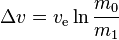
It's named after Konstantin Tsiolkovsky, just so you know.
Don't worry, it's not as bad as it looks.
Let's unpack it. First, moving from the left to the right, we have this symbol: Δv It is pronounced delta-vee. That is the mathematical way of describing change in velocity. If a spacecraft has a Delta-V of 1,200m/s, then, if it was in a gravity free vacuum, it would be traveling at 1,200m/s after it had burned all of it's fuel.
Now, we have the rest of the equation, starting with, which is the effective exhaust velocity. In other words, how fast the exhaust from the rocket comes out. The faster it comes out, the more efficient the rocket is.
Then there's , which is the natural logarithm, and that accounts for the fact that the rocket accelerates faster as it uses up fuel.
Finally, to factor in the mass fraction, which is how much fuel mass to ship mass there is in the ship. If it's higher, there is more "stuff" to be used for propellant.
If you add it all together, you get a formula which can tell you how far your rocket can go.
And here are some people who explain it better than I:
Wikipedia
Randall Munroe
William Greene
Don Pettit
This is my blog on rocket science, astronomy, and spaceflight! I will post interesting space news for your entertainment.
The name of my blog, Delta-V, comes from the basic piece of math from which most rocket science is based; The Tsiolkovsky rocket equation. Which is, quite simply, a way of finding out how far a rocket could get, in a perfect universe. It looks like this:
It's named after Konstantin Tsiolkovsky, just so you know.
Don't worry, it's not as bad as it looks.
Let's unpack it. First, moving from the left to the right, we have this symbol: Δv It is pronounced delta-vee. That is the mathematical way of describing change in velocity. If a spacecraft has a Delta-V of 1,200m/s, then, if it was in a gravity free vacuum, it would be traveling at 1,200m/s after it had burned all of it's fuel.
Now, we have the rest of the equation, starting with
, which is the effective exhaust velocity. In other words, how fast the exhaust from the rocket comes out. The faster it comes out, the more efficient the rocket is. Then there's
, which is the natural logarithm, and that accounts for the fact that the rocket accelerates faster as it uses up fuel.Finally, to factor in the mass fraction, which is how much fuel mass to ship mass there is in the ship. If it's higher, there is more "stuff" to be used for propellant.
If you add it all together, you get a formula which can tell you how far your rocket can go.
And here are some people who explain it better than I:
Wikipedia
Randall Munroe
William Greene
Don Pettit
Subscribe to:
Posts (Atom)