Tuesday, February 28, 2017

Nuclear rockets

One of the most important measures of rocket engines is specific impulse, which is just how efficiently a engine burns fuel. It is almost the same thing as exhaust velocity, which is how fast the exhaust stream is going when it leaves the engine.

Most rockets use chemical engines which combine a fuel and an oxidizer to accelerate the exhaust products and provide thrust. Isps of chemical rockets max out at about 450 seconds. Nuclear thermal rockets get Isp from 900 seconds on up. This is because their exhaust velocity is not limited by the energy of a chemical reaction, as they use the heat from a nuclear reaction to accelerate hydrogen by expanding it inside the core of a reactor.

This is the simplest type of nuclear thermal propulsion, and NASA did some tests on it in the '50s and '60s. The problem is that it's performance is limited by the melting point of the reactor. There are a couple of types of nuclear thermal propulsion that avoid this problem in various ways:

Twisted ribbon, pebble bed

By changing the shape of the fuel rods in the reactor, you can increase the heat transfer to the propellant. Twisted ribbon looks like this:


Pebble bed reactors are made out of "pebbles" of fuel that look like this;


Pulsed solid-core

This type of engine works by pulsing the power at which the reactor runs at from its normal power level to far beyond what the materials that it is made could withstand. As the temperatures are momentary, the cooling system can keep it from melting down. This is even better than it sounds, as neutrons generated while it is at maximum power will heat the propellant even further.

Liquid core

Solving the problem of preventing your reactor from melting down by designing it to run while molten! Outside-the-box thinking.
Problem include keeping your molten core from escaping with the propellent.

Isp 1,500 seconds.

Gas core

The logical extension of the liquid core design by allowing the uranium to turn not just liquid but to gas.

The problem of preventing the uranium plasma from escaping is exacerbated with gas core.

Isps 1,800 seconds to 7,000 seconds with advanced designs.

Nuclear lightbulb


It works like an easybake oven, except the lightbulb is a uranium plasma contained by a quartz vessel that doesn't melt because quartz is transparent to the majority of the radiation that is emitted, and the cake is hydrogen travelling at 20 km/s. Ages 10 and up.

Isps between 2,000 and 3,000 seconds.


Fission fragment

This skips a separate propellant entirely and uses the split atoms from the fission as propellant. The original concept used discs coated with the fuel, but a more efficient design uses ground-up fuel (around 100 nanometers) which are magnetically contained before they fission.

Isp 100,000 to 1,000,000 seconds.


Nuclear pulse

Uses nuclear bombs as propulsion, by dropping them behind a strong plate that dampens the shock and heat enough that anyone on board doesn't die. It apparently would work, and was even tested with conventional explosives. Development stopped mostly due to the nuclear test ban treaty and that this is best suited to lift spacecraft from the ground to orbit.
[This] is not nuts, [this] is super-nuts
-Richard Courant on viewing an nuclear pulse engine test

Isp 4,000 to 7,000 (with fusion bombs)


Nuclear salt water

This is one of the most crazy concepts for a rocket engine ever made. Its fuel is 20% enriched uranium mixed at 2% with water. It is stored in tubes coated with some kind of moderator which prevents it from reaching critical mass inside the tanks. When it is injected into the combustion chamber, the uranium reaches critical mass and begins a nuclear detonation. This can be sustained with more of the fuel being injected into the chamber. This has the advantage of the nuclear pulse engine's high efficiency, with continuous thrust and the ability to work at small scales.


Monday, January 23, 2017

Cause of AMOS-6 failure

On September 1 last year, a SpaceX Falcon 9 rocket exploded during fueling for a engine test that SpaceX does before every launch.


Since then, SpaceX has been analyzing the data that they gathered before and during the anomaly.  Recently they posted this report detailing what happened.

The report says that the second stage exploded due to heat or pressure coming from something called COPV.  COPV stands for composite overwrapped pressure vessel, which is a kind of tank that, rather than being made out of a strong material, uses tightly wrapped carbon fiber wrapped around a thin internal aluminum tank.  This is simply the lightest way of making high pressure tanks (in this case, around 350 bar, or ~5000 psi), and was used extensively on the space shuttle.

This is what a cutaway of one looks like:

Here's a video of one being wrapped:

This kind is filament wound, which is what the Falcon 9 has.  Braided ones are stronger and don't fail as explosively (not that it would have mattered) and are even more fun to watch being made (this is just carbon fiber being braided, not over a tank): https://www.youtube.com/watch?v=E9_21CDLoBo

SpaceX uses these on their Falcon 9 in the second stage to hold helium that is used to fill up the tank as the fuel is pumped out, as the tank is airtight, it would crumple if pressure was not maintained.

There are three tanks in the second stage, visible in this image:


Here's a size comparison of one of those which survived reentry:


So, the report says that liquid oxygen got between the liner and the overwrap.  Normally this wouldn't be a problem, but somehow a buckle formed in the liner, like the way you can pop in the side of a plastic water bottle.  When the liquid oxygen pooled in that buckle, it may have also frozen, because SpaceX uses liquid oxygen that is not just liquid, but much colder and closer to solid oxygen (the kerosene fuel is also much colder than usual), which increases the amount of propellant that can be stored in a tank of the same size, and the performance of the engines, which is improved because more propellant can flow into the engine with pipes of the same size.

SpaceX will first change the fueling procedure, which worked perfectly on Iridium NEXT, and later they will change the COPV design.

Some articles have said that SpaceX's failures have been caused by a more silicone valley iteration based mentality, however I think that they have more to do with the fact that SpaceX is developing the first new rocket technology since the '70s.  If you look at failure rates from rockets from that time, you see even higher failure rates.  The Falcon 1 (the first SpaceX rocket) had a failure rate of 60% (3 out of 5 launches over 3 years) and the Falcon 9 has a 6.897% launch failure rate (1 out of 28, over 7 years)  not including partial failures.  The AMOS-6 failure is counted here despite not being a launch failure, as the payload was destroyed.

The total failure rate for all Falcon rockets is 14.71%, 5 out of 34, over 11 years.
Now, compare that to the Atlas ICBM variant D which flew 67 times in its ICBM (non Mercury-Atlas) configuration over 4 years (1959-1962), and had a 35.82% failure rate.  In Febuary of 1962, after 68 flights with 36.76% or 25 of those resulting in failure, NASA actually began launching this rocket with humans aboard.  This isn't as crazy as it sounds, as the launch escape system in use at the time had never failed.

Most of this information came from this image:

So, in short, I think that SpaceX's higher failure rate are caused by flying the most recently developed rocket.  There's actually a term for how new technologies fail more often while new, called the bathtub curve.


Thursday, September 29, 2016

Planetary Protection

Planetary protection is about preventing contamination of life between planets.  This for two reasons: first, so alien planets are kept in their natural state for study, and second, so Earth is not contaminated by possible harmful extraterrestrial life.  Mostly, this consists of attempting to sterilize spacecraft to different degrees depending on what category of planetary protection mission it is, which you can read about here.  The current best method of decontamination is cooking spacecraft at high heat for a couple of days.

However, the topic of this post is what humans should do when manned spacecraft travel to Mars.  It will not be possible to keep a manned spacecraft at the same level of sterilization, just because of the humans.

There are a couple of basic options that exist.

The science option:
Life on other planets should be preserved until it has been completely studied, without any confusion over whether said life has accidentally been moved from Earth.  In theory, you could record everything about a life form, and then it would not matter what happened to it, but in practice methods for studying things will always be improving, and so you will not learn everything about it.

The survival option:
Anything that could be dangerous to humanity without providing an equal or greater benefit should be destroyed.  This is maybe a reasonable, if callous, option for microbial life, but what if the life is more complex?

The preservation option:
Nothing must be destroyed or changed.  This sounds good, however, any exploration or travel to other planets changes them, and leaving planets alone will eventually result in a disaster destroying or changing things there.

So what's the best option?  None of them.
A good analogy for this things is colors.

These are squares are completely red, green and blue.


They are unarguably colors that would be a very bad choice for, say, a living room.  And a compelling argument for any color is how bad the other two would look.  If you imagined your living room painted that green, you would think that maybe that blue wasn't so bad.  The same with the options of planetary protection.  All options, when taken to their extreme, sound bad, and the strongest argument for any one option is how terrible the other two would be taken to their extreme.

Unfortunately, none of the options are the best one.  We must proceed with a mix of these, based on what kind of life we find of Mars, if any.


Wednesday, May 18, 2016

Thrust Vector Control

I'm trying a new format for this post, sort of like a Q&A.

Q: How do rockets steer?

A: Well, in a car steering refers to both figuring out where to go (looking at the road) and the actual physical mechanism that steers the wheels and changes the direction.  Which one do you mean?

Q: The physical mechanism.

A: Since rockets spend much of their time in a vacuum, the mechanism for steering must not rely on an external force, like fins do.  There are three ways that spacecraft do this: 1) with small rockets pointing in different directions, called reaction control thrusters.  This is Apollo's reaction control thrusters:


Credit: National Air & Space Museum, Smithsonian Institution.

And here is the Apollo CSM with the thrusters installed:


By National Aeronautics and Space Administration (Apollo Lunar Surface Journal (direct link)) [Public domain], via Wikimedia Commons

These are good for moving large spacecraft, but do burn a limited supply of fuel.

2) With reaction wheels.  This is where large spinning flywheels are sped up and slowed down to rotate the spacecraft.  These are beyond the scope of this post.

3) With thrust vector control.  Thrust vector control is where you rotate the engine bell a couple of degrees, effectively making part of the engines thrust go towards rotation of the spacecraft.  That is the steering losses talked about previously on this blog.  Thrust Vector Control (TVC) is good for moving large spacecraft easily with minimal added weight.  However, it can only work while the engines are firing.

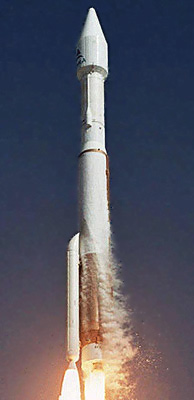
Almost all rockets use it during ascent, due to how much control authority is needed.  TVC is how seemingly unstable  rockets, like the Atlas 411 (http://space.skyrocket.de/img_lau/atlas-5-411__astra-1kr__2.jpg (Lockheed Martin))  or the Space Shuttle, both of which have a balance that changes a lot during flightl, are able to stay flying straight (of course, all Atlas variants are asymmetrical).  The Space Shuttle has an extremely large vector range, which you can see here: https://www.youtube.com/watch?v=7Wtg_3Y4lFc

The engine rotation mechanism is called a gimbal, and uses different ways of rotating the engine.  Basically, though, the engine is hinged in 2 axes above either the bell, or the entire engine.  The engine is then rotated with hydraulic or electromechanical actuators.  Now, you might notice that I only said 2 axes.  That is because you cannot provide roll control without some kind of off-center thrust.  Rockets either use multiple engines, gas generator exhaust vectoring (beyond the scope, again.), or just reaction control thrusters.

Until next time.